Abstract
Piezoelectric Energy Harvesting (PEH) plays a pivotal role in powering low-power electronic systems by leveraging ambient vibrations. However, the nonlinear and fluctuating nature of mechanical inputs leads to continuous variations in electrical output, making Maximum Power Point Tracking (MPPT) essential for efficient energy extraction. Traditional control methods based on fixed-duty cycle or pulses struggle to adapt to these dynamic conditions, resulting in significant energy loss. To address this challenge, this study proposes an innovative solution by developing an intelligent MPPT controller based on Artificial Neural Network (ANN). This controller is capable of adaptively determining the optimal duty cycle for a DC-DC Buck converter in real time. To generate the necessary training data for the network, an integrated simulation model was constructed-comprising a piezoelectric bender, a full-wave rectifier, and a lithium-ion battery-and evaluated under various vibration amplitudes and frequencies. The results demonstrated that the trained ANN achieved a remarkably high correlation coefficient (R = 0.99332), confirming its high accuracy and excellent generalization capability. Furthermore, simulation results proved the efficiency of the proposed system in significantly stabilizing the rectifier voltage, enhancing impedance matching, and improving battery charging performance. These findings demonstrate that utilizing an ANN-based MPPT provides a robust and effective solution for optimizing real-time energy harvesting and generation from piezoelectric vibration systems.
|
Published in
|
Science Research (Volume 14, Issue 3)
|
|
DOI
|
10.11648/j.sr.20261403.14
|
|
Page(s)
|
86-98 |
|
Creative Commons
|

This is an Open Access article, distributed under the terms of the Creative Commons Attribution 4.0 International License (http://creativecommons.org/licenses/by/4.0/), which permits unrestricted use, distribution and reproduction in any medium or format, provided the original work is properly cited.
|
|
Copyright
|
Copyright © The Author(s), 2026. Published by Science Publishing Group
|
Keywords
Piezoelectric Energy Harvesting, ANN, MPPT, Buck Converter, Matlab Simulink, Renewable Energy System
1. Introduction
Piezoelectric energy harvesting (PEH) has emerged as a prominent technology for powering autonomous, low-power electronic systems by converting ambient mechanical vibrations into usable electric energy. This approach offers a sustainable and maintenance-free power source for applications ranging from wireless sensor networks and structural health monitoring to wearable and implantable devices. However, the inherent characteristics of ambient vibration-such as variable amplitude, frequency, and non-stationary behavior-introduce significant challenges in extracting power efficiently. The electrical output of a piezoelectric generator is highly nonlinear and dynamically couples with the mechanical excitation, leading to continuous shifts in the optimal operating point, known as the maximum power point (MPP).
To address this, maximum power point tracking (MPPT) techniques are essential for dynamically adjusting the electrical load to match the source impedance, thereby maximizing power transfer. Conventional MPPT methods, including fixed-duty cycle control and perturbation-and-observation (P&O) algorithms, often exhibit limitations under real-world vibration conditions. These methods can fail to track rapid changes in the MPP, leading to power losses, reduced efficiency, and instability in the energy transfer process. Consequently, there is a pressing need for intelligent, adaptive control strategies capable of performing real-time optimization in dynamic and unpredictable vibration environments.
This research gap motivates the exploration of artificial intelligence-based solutions, particularly artificial neural networks (ANNs), which offer strong capabilities in modeling nonlinear systems and making rapid, data-driven decisions. While ANNs have been applied in various control and prediction tasks, their integration into real-time MPPT for piezoelectric energy harvesting under wide-ranging vibrational conditions remains underexplored. Existing studies often lack comprehensive validation under realistic. Time-varying inputs or do not fully leverage the ANN's ability to generalize across unseen operational states.
The development of a dedicated ANN-driven MPPT controller tailored for PEH system. The proposed system is designed to continuously adapt the duty cycle of DC-DC buck converter based on real-time piezoelectric voltage measurements, thereby ensuring optimal impedance matching under vibration excitation. A high-fidelity simulation model of the complete energy harvesting chain-comprising the piezoelectric bender, full-wave rectifier, buck converter, and lithium-ion battery-is developed in MATLAB/Simulink to generate extensive training data across diverse operational scenarios. The ANN is trained to capture the intricate nonlinear mapping between the harvester's electrical state and the corresponding optimal duty cycle, enabling precise and rapid MPPT without prior knowledge of the mechanical input characteristics.
2. Literature Review
Piezoelectric Energy Harvesting (PEH) has attracted considerable research interest as a sustainable and maintenance-free power solution for low-power autonomous systems, particularly in applications such as wireless sensor networks, wearable electronics, and structural health monitoring systems
. Despite its promising potential, the performance of PEH systems is inherently constrained by the nonlinear and time-varying characteristics of ambient mechanical vibrations. These variations result in continuous shifts of the system’s operating point, making efficient Maximum Power Point Tracking (MPPT) essential for maximizing energy extraction.
Conventional MPPT techniques, including fixed-duty-cycle control and the Perturb and Observe (P&O) method, have been widely investigated due to their simplicity and low computational requirements. However, under dynamic and non-stationary vibration conditions, such methods often fail to accurately track the optimal operating point, leading to suboptimal power transfer and reduced overall system efficiency
| [2] | Ali, A. K., Abdulrazzaq, A. A., & Mohsin, A. H. (2024). A dynamic simulation of a piezoelectric energy-harvesting system integrated with a closed-loop voltage source converter for sustainable power generation. Processes, 12(10), 2198.
https://doi.org/10.3390/pr12102198 |
| [3] | Bhatia, D., Sharma, P., & Kumar, A. (2013). Piezoelectric generators for vibrational energy harvesting. International Journal of Engineering Research & Technology, 2(12), 1-6. |
| [4] | Clementino, M. A., Reginatto, R., & da Silva, S. (2014). Modeling of piezoelectric energy harvesting considering the dependence of the rectifier circuit. Journal of the Brazilian Society of Mechanical Sciences and Engineering, 36, 283–292. https://doi.org/10.1007/s40430-013-0070-6 |
[2-4]
. Consequently, there is a growing need for adaptive and intelligent MPPT strategies capable of handling the nonlinear behavior and rapid variations inherent in real-world piezoelectric energy harvesting environments.
2.1. Traditional and Adaptive MPPT Techniques
Conventional MPPT approaches, such as fixed-duty cycle and P&O algorithms, have been widely implemented due to their simplicity and low computational cost. However, their performance degrades significantly under rapidly changing mechanical inputs, as they cannot promptly adapt to the optimal operating point
| [9] | Khalili, M., Biten, A. B., Vishwakarma, G., Ahmed, S., & Papagiannakis, A. (2019). Electro-mechanical characterization of a piezoelectric energy harvester. Applied Energy, 253, 113585. https://doi.org/10.1016/j.apenergy.2019.113585 |
[9]
. To address this, adaptive methods including incremental conductance and fractional open-circuit voltage have been proposed, offering improved tracking speed and accuracy under moderate variations
| [3] | Bhatia, D., Sharma, P., & Kumar, A. (2013). Piezoelectric generators for vibrational energy harvesting. International Journal of Engineering Research & Technology, 2(12), 1-6. |
[3]
. Despite these improvements, such methods still rely on pre-defined heuristics and may struggle with highly nonlinear or multi-frequency vibrations, a common scenario in real-world environments
| [6] | Hamdan, C., Allport, J., & Sajedin, A. (2021). Piezoelectric Power Generation from the Vortex-Induced Vibrations of a Semi-Cylinder Exposed to Water Flow. Energies, 14(21), 6964. https://doi.org/10.3390/en14216964 |
[6]
.
2.2. Intelligent and AI-based MPPT Controllers
The integration of artificial intelligence (AI) techniques, particularly Artificial Neural Networks (ANNs), has emerged as a promising direction for real-time MPPT in PEH systems. ANNs excel in modeling complex, nonlinear relationships without requiring explicit system equations, making them suitable for dynamic vibration environments
| [12] | Salem, M. S., et al. (2021). Bandwidth broadening of piezoelectric energy harvesters using arrays of a proposed piezoelectric cantilever structure. Micromachines, 12(8), 973. https://doi.org/10.3390/mi12080973 |
[12]
.
Recently,
developed an adaptive ANN-based MPPT controller designed to optimize power transfer from a piezoelectric vibration energy harvesting system to a load. The study utilized a simplified multilayer perceptron network with a single hidden layer of 10 nodes to directly map the instantaneous rectified voltage to the optimal duty cycle of a DC-DC buck converter. Crucially, the author provided experimental validation demonstrating that this neural network approach yields significantly higher power extraction efficiency compared to conventional Perturb-and-Observe (P&O) methods, particularly under highly dynamic and rapidly changing mechanical excitations. While that study relied on experimental validation with a specific architectural footprint, further investigation into the holistic integration with battery storage and deeper analysis of the network
s training correlation parameters remains an open area for simulation-driven optimization.
2.3. ANN Applications in PEH
While numerous studies have employed machine learning techniques for system modeling, performance prediction, or fault diagnosis in energy harvesting applications, only a limited number have addressed real-time, ANN-driven Maximum Power Point Tracking (MPPT) for piezoelectric energy harvesting systems operating under wide and dynamically varying conditions. For instance,
| [12] | Salem, M. S., et al. (2021). Bandwidth broadening of piezoelectric energy harvesters using arrays of a proposed piezoelectric cantilever structure. Micromachines, 12(8), 973. https://doi.org/10.3390/mi12080973 |
[12]
utilized Kalman filter–based approaches for prognostics and health management of vibrating electronic systems; however, their work did not consider power optimization or energy extraction efficiency.
More recently,
| [7] | Ismail, M. H. B., & Husaini, Y. (2021). Design and optimization of piezoelectric cantilever for energy harvesting application by using Taguchi method. Journal of Physics: Conference Series, 2120(1), 012015.
https://doi.org/10.6007/IJARBSS/v11-i9/10342 |
[7]
applied the Taguchi optimization method to enhance the structural design of a piezoelectric cantilever for energy harvesting applications. Although their results demonstrated improved design performance, the proposed approach was conducted offline and did not incorporate adaptive or real-time control during system operation. Furthermore, many existing ANN-based PEH studies lack comprehensive validation under realistic, time-varying mechanical excitation, which significantly limits their practical applicability in real-world environments
. Early investigations by
| [14] | Sood, R., Jeon, Y., Jeong, J., & Kim, S. (2004). Piezoelectric micro power generator for energy harvesting. In *Technical Digest of the 2004 Solid-State Sensor and Actuator Workshop* (pp. 371–374). Hilton Head, SC. |
[14]
on piezoelectric micro power generators further emphasized the difficulty of maintaining high energy conversion efficiency under variable vibration amplitudes—a challenge that intelligent, adaptive control strategies are particularly well positioned to address.
2.4. Comparative Analysis with the Proposed ANN-MPPT System
The ANN-based MPPT controller proposed in the current study advances prior research by providing a fully adaptive, real-time duty cycle optimization based solely on piezoelectric voltage feedback. Unlike the fixed-control benchmarks used in studies such as
| [8] | Kan, J., Ross, R. J., Wang, X., & Li, W. (2017). Energy harvesting from wood floor vibration using a piezoelectric generator. *Research Note, FPL-RN-0347*. US Department of Agriculture, Forest Service, Forest Products Laboratory.
https://doi.org/10.2737/FPL-RN-347 |
| [9] | Khalili, M., Biten, A. B., Vishwakarma, G., Ahmed, S., & Papagiannakis, A. (2019). Electro-mechanical characterization of a piezoelectric energy harvester. Applied Energy, 253, 113585. https://doi.org/10.1016/j.apenergy.2019.113585 |
| [10] | Lall, P., Lowe, R., & Goebel, K. (2012). Prognostics health management of electronic systems under mechanical shock and vibration using Kalman filter models and metrics. IEEE Transactions on Industrial Electronics, 59(11), 4301–4314.
https://doi.org/10.1109/TIE.2012.2183834 |
| [11] | Minazara, E., Vasic, D., & Costa, F. (2008). Piezoelectric generator harvesting bike vibrations energy to supply portable devices. Renewable Energy & Power Quality Journal, 6(1), 589–592. https://doi.org/10.24084/repqj06.344 |
[8-11]
, the proposed system dynamically adjusts impedance matching, leading to stabilized rectifier voltage and enhanced battery charging rates. The achieved correlation coefficient (R=0.99332) and consistent performance gains across test scenarios demonstrate superior generalization compared to earlier adaptive controllers, such as the P&O-based system simulated by
| [2] | Ali, A. K., Abdulrazzaq, A. A., & Mohsin, A. H. (2024). A dynamic simulation of a piezoelectric energy-harvesting system integrated with a closed-loop voltage source converter for sustainable power generation. Processes, 12(10), 2198.
https://doi.org/10.3390/pr12102198 |
[2]
. Furthermore, the integration of a full system model—from piezoelectric bender to battery—within MATLAB/Simulink provides a more holistic validation framework than many prior works, which often focused on isolated components
| [6] | Hamdan, C., Allport, J., & Sajedin, A. (2021). Piezoelectric Power Generation from the Vortex-Induced Vibrations of a Semi-Cylinder Exposed to Water Flow. Energies, 14(21), 6964. https://doi.org/10.3390/en14216964 |
| [7] | Ismail, M. H. B., & Husaini, Y. (2021). Design and optimization of piezoelectric cantilever for energy harvesting application by using Taguchi method. Journal of Physics: Conference Series, 2120(1), 012015.
https://doi.org/10.6007/IJARBSS/v11-i9/10342 |
| [8] | Kan, J., Ross, R. J., Wang, X., & Li, W. (2017). Energy harvesting from wood floor vibration using a piezoelectric generator. *Research Note, FPL-RN-0347*. US Department of Agriculture, Forest Service, Forest Products Laboratory.
https://doi.org/10.2737/FPL-RN-347 |
| [9] | Khalili, M., Biten, A. B., Vishwakarma, G., Ahmed, S., & Papagiannakis, A. (2019). Electro-mechanical characterization of a piezoelectric energy harvester. Applied Energy, 253, 113585. https://doi.org/10.1016/j.apenergy.2019.113585 |
[6-9]
.
2.5. Methodological Comparison of Optimization Strategies for Piezoelectric Energy Harvesting
Within the context of developing piezoelectric energy harvesting systems, three primary methodological strategies emerge, reflecting a progressive evolution in addressing the challenge of efficiently extracting energy from variable mechanical vibrations. The first paper relies on Structural and Numerical Optimization, focusing on improving the physical design of the piezoelectric transducer (M-shape) using numerical modeling in COMSOL followed by the application of artificial intelligence algorithms to achieve optimal parameters
| [1] | Ali, A., Sheeraz, M. A., Bibi, S., Khan, M. Z., Malik, M. S., & Ali, W. (2021). Artificial neural network (ANN)-based optimization of a numerically analyzed m-shaped piezoelectric energy harvester. Functional Materials Letters, 14(08), 2151046. https://doi.org/10.1142/S1793604721510462 |
[1]
. In contrast, the second paper leans towards Electronic Optimization through traditional MPPT circuits to maximize power transfer without reliance on machine learning techniques
| [5] | X. -D. Do, S. -K. Han and S. -G. Lee, "Optimization of piezoelectric energy harvesting systems by using a MPPT method," 2014 IEEE Fifth International Conference on Communications and Electronics (ICCE), Danang, Vietnam, 2014, pp. 309-312, https://doi.org/10.1109/CCE.2014.6916720 |
[5]
. The recent paper represents an Intelligent Integrated Approach that combines the advantages of structural and electronic optimization by using artificial neural networks for real-time maximum power point tracking.
3. System Modeling
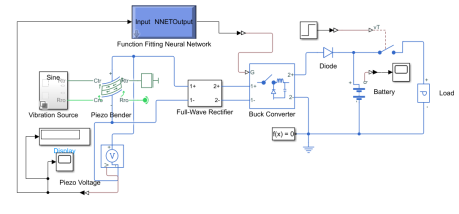
A high-fidelity, integrated model of the piezoelectric energy harvesting (PEH) system was developed and simulated within the MATLAB/Simulink environment to accurately capture the electromechanical dynamics and power conversion processes. The system architecture, illustrated in
Figure 1, Integrates Five key subsystems: a vibration source, a piezoelectric bending transducer, a full-wave bridge rectifier, a DC-DC buck converter, and a rechargeable lithium-ion battery. Each component was mathematically and electrically modeled to reflect its physical characteristics and dynamic interactions, enabling a realistic simulation of energy flow from mechanical vibration excitation to electrical storage.
Figure 1. Vibration Energy Harvesting System Model.
3.1. Piezoelectric Bender Model
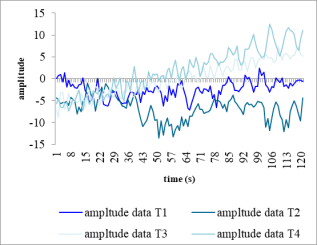
The piezoelectric element was represented using its standard equivalent electric circuit, consisting of a current source in parallel with a capacitor and resistor. This formulation accurately captures the conversion of mechanical strain into electrical charge based on the direct effect. The mechanical excitation was derived from real vibration datasets as shown in
Figure 2. represented as time-varying sinusoidal input with varying amplitudes.
Figure 2. Vibration Amplitude Datasets for test 1, test 2, test 3, and test 4.
3.2. Power Conditioning and Storage Model
A full-wave diode bridge rectifier was used to convert the AC output of the piezoelectric bender into DC voltage. The rectified signal then feeds a buck converter responsible for regulating the voltage delivered to the battery. The buck converter model includes a MOSFET switch, inductor, diode, and output capacitor.
The duty cycle of the buck converter is the primary control variable, directly influencing the input impedance seen by the piezoelectric voltage source. This relationship enables MPPT through impedance matching. Where the optimal duty cycle maximizes power transfer.
A 12 V, 20 Ah lithium-ion batteries was modeled using a standard equivalent circuit including internal resistance and nominal capacity. The battery serves as the energy storage unit for evaluating the effectiveness of each control strategy. Accumulated charge (mAh) is used as a direct indicator of harvested energy.
3.3. Data Generation and ANN Controller Implementation
To develop and validate the proposed control strategy, the complete system model was subjected to extensive simulation under a wide range of operating conditions. Initial simulations were conducted both with and without the final ANN-based controller to establish performance baselines and generate the necessary training dataset. The system was excited across a comprehensive sweep of vibration frequencies and amplitudes, emulating realistic non-stationary environments. From these simulations, the key input-output relationship for controller training was extracted: the instantaneous piezoelectric voltage, , and its corresponding optimal buck converter duty cycle, , which yields the maximum possible power output, , from the harvester at each operating point.
Table 1 shows the architecture and training parameters of the Artificial Neural Network (ANN) designed for Maximum Power Point Tracking (MPPT).
Table 1. Artificial Neural Network configuration and training Parameters.
Parameter | Value |
Input Data | Piezo-voltage |
Hidden layers | 10 |
Response/Target | Buck Converter-optimal Duty Cycle Cy |
Data Division | Training data 70% |
Validation data 15% |
Test data 15% |
Figure 3. Structure of the ANN-based MPPT Controller showing input, hidden Layers and output.
Figure 3 illustrates the architecture of the proposed Artificial Neural Network (ANN) controller responsible for real-time Maximum Power Point Tracking (MPPT).
3.4. ANN Controller Function and Real-time Optimization
The ANN-based controller functions as the adaptive core of the MPPT system, executing a real-time, nonlinear mapping to optimize power extraction. Its primary input is the piezoelectric voltage (, a stable DC parameter that directly correlates with the instantaneous power available from the harvester. The network processes this input to generate a single output: the optimal duty cycle ) for the PWM-controlled buck converter. This value is fed directly to the converter's gate driver, dynamically adjusting the switch's on-time. By continuously computing based on real-time measurements of , the controller enables the converter's input impedance to adaptively match the time-varying optimal impedance of the piezoelectric source. This closed-loop impedance matching ensures the system consistently operates at or near the Maximum Power Point (MPP), thereby maximizing the power transferred to the load and overcoming the inherent limitations of static, fixed-duty-cycle control strategies under dynamic vibration conditions.
3.5. Piezo Bender Properties and Battery Data
The operational efficacy of a piezoelectric energy harvesting system is fundamentally governed by two interconnected domains: the electromechanical properties of the transducer and the electrical characteristics of the storage unit. The piezoelectric bender, typically configured as a bimorph or unimorph cantilever, is characterized by its geometric dimensions, material constants (including the piezoelectric coefficients and dielectric properties), and its dynamic response to mechanical excitation, which collectively determine its power generation capability via the Direct Piezoelectric Effect. Concurrently, the performance of the integrated system is equally constrained by the specifications of the energy storage element, as detailed in
Table 3. The battery's parameters—such as its nominal voltage, internal resistance, and capacity—are critical for assessing the impedance matching and energy acceptance capability of the downstream circuit. Therefore, a holistic evaluation of system viability, from mechanical-to-electrical conversion to effective storage and delivery of power to a connected load, necessitates the concurrent analysis of both the harvester's source characteristics and the battery's sink characteristics.
Table 2. Mechanical and electric properties of the Piezoelectric Bender.
Parameter | Value |
Number of Elements | 1 |
Total Beam Length | 30 (cm) |
Beam Width | 4 (cm) |
Beam Thickness | 0.5 (cm) |
Young Modulus | 70 (Gpa) |
Piezoelectric Stress Coefficient | 150 (C/m^2) |
Dielectric Constant | 1.39e-08 (F/m) |
Rayleigh Damping Constant | 1e-5 (s) |
Beam Mass | 100 (g) |
Table 3. Lithium-ion battery Parameters using in the simulation model.
Parameter | Value |
Nominal Voltage, Vonm | 12 (V) |
Internal Resistance | 0.1 (Ohm) |
Cell Capacity (Ah) | 4 (Ah) |
Table 3 shown the key specifications of the piezoelectric bender (cantilever) used as the energy-harvesting core in this study. These properties define the element's electromechanical performance and its ability to convert vibrations into electrical energy.
3.6. Artificial Neural Network Performance Evaluating
Figure 4. ANN Training and Validation, Performance (Mean Squared Error vs. Epoch) for Test 1.
Figure 5. ANN Error plot demonstrating prediction deviation.
The learning convergence and predictive stability of the trained Artificial Neural Network (ANN) for Maximum Power Point Tracking (MPPT) control were quantitatively evaluated using the Mean Squared Error (MSE) as the primary performance metric.
The Artificial Neural Network was trained using a dedicated dataset, with the progressive minimization of the Training Mean Squared Error (MSE)—as shown in
Figure 4. —confirming successful learning of the nonlinear mapping from the input piezoelectric voltage (
) to the target optimal duty cycle (
). To ensure robust generalization and prevent over fitting, a separate validation dataset was monitored during training; the consistent decrease in validation MSE until convergence indicated stable learning without memorization. The final model's performance was then evaluated on an unseen test dataset, where the closely aligned error trend demonstrated its capability to generalize to novel operating conditions. The culmination of this process is an ANN that functions as a real-time, nonlinear function approximated. Its final output layer synthesizes the processed input to produce a single scalar command: the optimal duty cycle.
This value is directly fed to the PWM generator of the buck converter, enabling instantaneous impedance matching for maximum power point tracking within the closed-loop energy harvesting system.
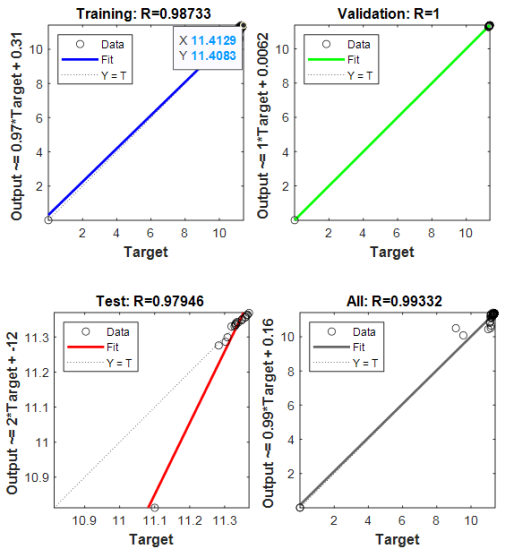
The accuracy and generalization capability of the trained Artificial Neural Network (ANN) were rigorously validated through a comprehensive regression analysis, as presented in
Figure 6. This analysis evaluates the statistical correlation between the network's predicted outputs and the corresponding target values (true optimal duty cycles) from the dataset. The strength of the linear relationship is quantified by the correlation coefficient R, where a value approaching unity signifies a high degree of agreement between predictions and targets, thereby confirming the model's precision and its robust ability to generalize the underlying input-output mapping beyond the training data.
Figure 6. ANN predicted Optimal Duty Cycle compared with target values.
The regression plot presented in
Figure 7. conclusively validates the efficacy of the trained Artificial Neural Network (ANN) in accurately modeling the complex, nonlinear input-output relationship that defines the optimal control characteristic essential for real-time Maximum Power Point Tracking (MPPT) within the piezoelectric energy harvesting system.
Figure 7. ANN Function Fitting regression Analysis.
4. Results
4.1. Analysis Piezoelectric Voltage
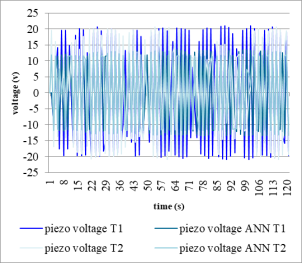
The time-domain representation of the piezoelectric voltage
under different control schemes, presented in
Figure 8 and
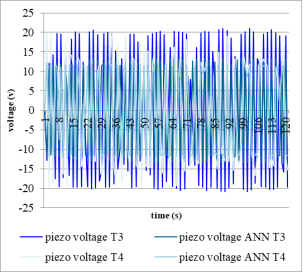
Figure 9. provides a comparative analysis of the raw electrical output generated by the transducer. The voltage exhibits a characteristic alternating current (AC) waveform, oscillating between approximately ±20 V, with a frequency directly corresponding to the mechanical excitation input, thereby confirming the dynamic and oscillatory nature of the ambient vibrational energy source. A critical observation from the superimposed plots is the consistent peak-to-peak amplitude of
across all tested scenarios—namely, the fixed-duty pulse generator (T1, T2, T3 and T4) and the ANN-based MPPT controller (ANN T1, ANN T2, ANN T3 and ANN T4). The tight grouping and substantial overlap of these voltage traces indicate that the open-circuit voltage generated by the piezoelectric element is primarily governed by the mechanical input strain and is not substantially altered by the downstream power electronics control strategy. This underscores that the superiority of the ANN controller must be evaluated not in the raw voltage generation, but in its ability to optimally
extract and transfer this available power through superior impedance matching, as evidenced in subsequent electrical metrics.
Figure 8. Piezoelectric voltage response for T1, T2, ANN T1 and ANN T2.
Figure 9. Piezoelectric voltage response for T3, T4, ANN T3 and ANN T4.
4.2. Analysis of Rectifier Voltage Dynamics and MPPT Efficacy
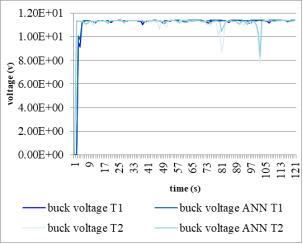
The dynamic behavior of the rectifier voltage
, illustrated in
Figure 10 and
Figure 11. provides a critical comparative assessment of the benchmark fixed-duty control (T1, T2, T3 and T4) and the proposed ANN-based MPPT controller (ANN T1, ANN T2, ANN T3 and ANN T4). Under fixed control, exhibits a wide, oscillatory range with peaks approaching 20 V and significant troughs, indicative of persistent impedance mismatch.
These large fluctuations occur because a static duty cycle cannot adapt to the harvester's time-varying optimal impedance; consequently, power is not efficiently drawn from the source, leading to high open-circuit voltage spikes and substantial power loss. In contrast, the ANN-controlled system demonstrates a markedly stabilized voltage profile, characterized by a narrower and consistently lower amplitude band. This stabilization is a direct manifestation of effective, real-time impedance matching: by continuously computing and applying the optimal duty cycle , the ANN adjusts the converter's input impedance to match the source impedance, thereby maximizing current draw and pulling down to its optimal operating voltage. The pronounced reduction in voltage fluctuation and peak magnitude under ANN control conclusively validates the successful implementation of an adaptive MPPT strategy, ensuring near-continuous operation at the maximum power point and superior energy extraction efficiency compared to the static control paradigm.
Figure 10. Rectifier voltage for T1, T2, ANN T1 and ANN T2.
Figure 11. Rectifier voltage for T3, T4, ANN T3 and ANN T4.
4.3. Analysis of Buck Converter Output Voltage
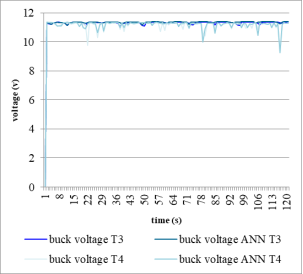
The output voltage of the buck converter, presented in
Figure 12 and
Figure 13, demonstrates effective output regulation, maintaining a stable level appropriate for battery charging. It is critical to note that this voltage stability, while indicative of proper converter function, is not the principal manifestation of the ANN controller's optimization. The core achievement of the ANN-based MPPT lies in the upstream impedance matching at the converter's input, which maximizes the power extracted from the piezoelectric source. This optimized power extraction is directly reflected in an increased average charging current delivered to the battery, thereby enhancing the overall energy transfer efficiency and fulfilling the fundamental objective of maximum power point tracking, rather than being evidenced by the well-regulated output voltage alone.
Figure 12. Buck Converter output voltage for T1, T2, ANN T1 and ANN T2 scenarios.
Figure 13. Buck Converter output voltage for T3, T4, ANN T3 and ANN T4 scenarios.
4.4. Analysis of Buck Converter Input Pulse and Duty Cycle Modulation
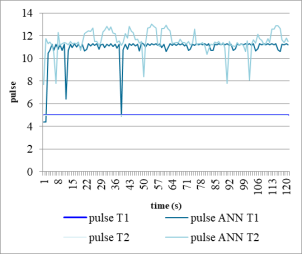
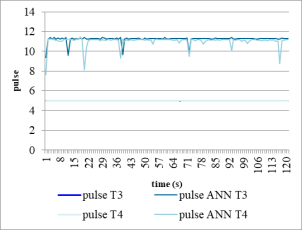
The defining operational distinction between the control strategies is evidenced in the temporal characteristics of the buck converter's input pulse signal, where the pulse width corresponds directly to the duty cycle D. As illustrated in
Figure 14 and
Figure 15, the fixed-control strategy (T1, T2, T3 and T4) generates a pulse train with a constant duty cycle, where any observable minor variations are attributable to system noise rather than intentional control adaptation. In stark contrast, the pulse train under ANN-based control (ANN T1, ANN T2, ANN T3 and ANN T4) exhibits continuous and deliberate modulation of the pulse width.
Figure 14. Buck Converter pulse for fixed-duty and ANN-based MPPT control for T1, T2, ANN T1 and ANN T2.
Figure 15. Buck Converter pulse for fixed-duty and ANN-based MPPT control for T3, T4, ANN T3 and ANN T4.
This dynamic variation results from the real-time adjustment of the duty cycle by the ANN controller, which outputs the calculated optimal duty cycle in response to the instantaneous electrical state of the harvester. This adaptive modulation of the control signal is the fundamental mechanism enabling the real-time impedance matching required for effective Maximum Power Point Tracking.
4.5. Analysis of Battery Charge Accumulation
The cumulative charge accumulation in the battery measured in milliampere-hours (mAh) and plotted in
Figure 16 and
Figure 17 serves as the definitive metric for comparing system-level harvesting efficiency. While all scenarios exhibit a positive upward trend, the slopes of the accumulation curves reveal a pronounced performance advantage for the ANN-based control system. The benchmark fixed-duty control (mAh T1, T2, T3 and T4) demonstrates a steady but comparatively shallow slope, indicating a lower average rate of charge accumulation attributable to persistent impedance mismatch and consequent suboptimal power transfer. In contrast, the trajectories for the ANN-controlled system (mAh ANN T1, mAh ANN T2, mAh ANN T3 and mAh ANN T4) display a significantly steeper slope, culminating in the highest final accumulated charge.
Figure 16. Battery accumulated charge (mAh) under fixed-duty and ANN-based control T1, T2, ANN T1 and ANN T2.
Figure 17. Battery accumulated charge (mAh) under fixed-duty and ANN-based control T3, T4, ANN T3 and ANN T4.
This marked increase in the rate of charge accumulation provides direct empirical evidence of the ANN-MPPT controller's efficacy; by continuously modulating the duty cycle in real-time, the controller ensures optimal impedance matching is maintained, thereby maximizing the power extracted from the piezoelectric source and transferred to the battery throughout the operational period.
5. Result Discussion
The proposed ANN-based MPPT controller demonstrated a marked ability to achieve dynamic impedance matching in real time, as evidenced by the significant stabilization of the rectifier voltage when compared to conventional fixed-duty-cycle operation. The reduction in voltage fluctuations and lower peak magnitudes reflect an optimized power extraction process from the piezoelectric source, confirming the controller’s adaptability to instantaneous variations in mechanical vibration.
Furthermore, the intelligent control strategy improved overall energy transfer efficiency and system stability. This was clearly observed through the increased rate of battery charge accumulation, which resulted from enhanced impedance matching at the input side of the buck converter. While output voltage regulation remained consistent across all test scenarios, the rise in average charging current underscores the effectiveness of the ANN in maximizing power capture rather than merely maintaining output stability.
The ANN itself exhibited high predictive accuracy and generalization capability, achieving a correlation coefficient of R = 0.99332 between predicted and target duty cycle values. This strong performance validates the network’s ability to model the complex, nonlinear relationship between piezoelectric voltage and the optimal duty cycle, making it a reliable and practical solution for real-time MPPT under varying operational conditions.
From a practical perspective, although the quantitative gain in accumulated charge appears modest, such incremental improvements are critically important in low-power energy harvesting applications. In environments where mechanical input is highly variable, even marginal enhancements in energy extraction can determine the operational reliability and autonomy of electronic systems. These findings collectively support the adoption of ANN-driven MPPT as a robust and efficient approach for optimizing piezoelectric energy harvesting in real-world scenarios.
6. Conclusion
This study has demonstrated the efficacy of an Artificial Neural Network-based Maximum Power Point Tracking controller in enhancing the operational efficiency of piezoelectric vibration energy harvesting systems. Through the generation of a comprehensive dataset via duty-cycle sweeps across diverse vibrational conditions, the ANN was successfully trained to learn the complex, nonlinear relationship between the instantaneous rectifier voltage and the corresponding optimal buck converter duty cycle. Simulation results substantiate that the proposed intelligent control strategy significantly improves rectifier voltage stability, achieves dynamic impedance matching, and increases the total power transferred to the energy storage unit, when benchmarked against conventional fixed-duty-cycle operation. Although the quantified performance gains are modest in magnitude, they represent a meaningful advancement for low-power harvesting systems where marginal improvements in energy extraction are critical for functionality under fluctuating mechanical inputs. These findings collectively establish ANN-driven MPPT as a robust and efficient methodology for real-time optimization in piezoelectric energy harvesting applications.
Future research directions will focus on the experimental validation of the proposed controller through hardware-in-the-loop testing and physical prototyping. Further enhancements may involve the integration of multi-modal vibration sensing for broader environmental adaptation, and the exploration of advanced hybrid learning architectures—such as neuro-fuzzy systems or reinforcement learning—to improve convergence speed, adaptability, and resilience in highly unpredictable operational environments.
Abbreviations
AC | Alternating Current |
AI | Artificial Intelligence |
ANN | Artificial Neural Network |
DC | Direct Current |
IoT | Internet of Things |
Li-ion | Lithium-ion (Battery) |
MPP | Maximum Power Point |
MPPT | Maximum Power Point Tracking |
MSE | Mean Squared Error |
PEH | Piezoelectric Energy Harvesting |
PZT | Lead Zirconate Titanate |
PWM | Pulse Width Modulation |
R | Correlation Coefficient (Regression) |
WSN | Wireless Sensor Network |
T1 | Test 1 |
T2 | Test 2 |
ANN T1 | Artificial Neural Network Based Control for Test 1 |
ANN T2 | Artificial Neural Network Based Control for Test 2 |
mah | Battery Milliampere-hours |
Dopt | Optimal Duty Cycle |
D | Duty Cycle |
PMAX | Maximum Possible Power Output |
Vpiezo | Piezoelectric Voltage |
Vrectifier | Rectifier Voltage |
Author Contributions
Ismail Alazhari Abubaker Bashar Omer: Methodology, Resources, Writing – original draft, Data curation, Writing –review & editing
Conflicts of Interest
The author declares no conflicts of interest.
References
| [1] |
Ali, A., Sheeraz, M. A., Bibi, S., Khan, M. Z., Malik, M. S., & Ali, W. (2021). Artificial neural network (ANN)-based optimization of a numerically analyzed m-shaped piezoelectric energy harvester. Functional Materials Letters, 14(08), 2151046.
https://doi.org/10.1142/S1793604721510462
|
| [2] |
Ali, A. K., Abdulrazzaq, A. A., & Mohsin, A. H. (2024). A dynamic simulation of a piezoelectric energy-harvesting system integrated with a closed-loop voltage source converter for sustainable power generation. Processes, 12(10), 2198.
https://doi.org/10.3390/pr12102198
|
| [3] |
Bhatia, D., Sharma, P., & Kumar, A. (2013). Piezoelectric generators for vibrational energy harvesting. International Journal of Engineering Research & Technology, 2(12), 1-6.
|
| [4] |
Clementino, M. A., Reginatto, R., & da Silva, S. (2014). Modeling of piezoelectric energy harvesting considering the dependence of the rectifier circuit. Journal of the Brazilian Society of Mechanical Sciences and Engineering, 36, 283–292.
https://doi.org/10.1007/s40430-013-0070-6
|
| [5] |
X. -D. Do, S. -K. Han and S. -G. Lee, "Optimization of piezoelectric energy harvesting systems by using a MPPT method," 2014 IEEE Fifth International Conference on Communications and Electronics (ICCE), Danang, Vietnam, 2014, pp. 309-312,
https://doi.org/10.1109/CCE.2014.6916720
|
| [6] |
Hamdan, C., Allport, J., & Sajedin, A. (2021). Piezoelectric Power Generation from the Vortex-Induced Vibrations of a Semi-Cylinder Exposed to Water Flow. Energies, 14(21), 6964.
https://doi.org/10.3390/en14216964
|
| [7] |
Ismail, M. H. B., & Husaini, Y. (2021). Design and optimization of piezoelectric cantilever for energy harvesting application by using Taguchi method. Journal of Physics: Conference Series, 2120(1), 012015.
https://doi.org/10.6007/IJARBSS/v11-i9/10342
|
| [8] |
Kan, J., Ross, R. J., Wang, X., & Li, W. (2017). Energy harvesting from wood floor vibration using a piezoelectric generator. *Research Note, FPL-RN-0347*. US Department of Agriculture, Forest Service, Forest Products Laboratory.
https://doi.org/10.2737/FPL-RN-347
|
| [9] |
Khalili, M., Biten, A. B., Vishwakarma, G., Ahmed, S., & Papagiannakis, A. (2019). Electro-mechanical characterization of a piezoelectric energy harvester. Applied Energy, 253, 113585.
https://doi.org/10.1016/j.apenergy.2019.113585
|
| [10] |
Lall, P., Lowe, R., & Goebel, K. (2012). Prognostics health management of electronic systems under mechanical shock and vibration using Kalman filter models and metrics. IEEE Transactions on Industrial Electronics, 59(11), 4301–4314.
https://doi.org/10.1109/TIE.2012.2183834
|
| [11] |
Minazara, E., Vasic, D., & Costa, F. (2008). Piezoelectric generator harvesting bike vibrations energy to supply portable devices. Renewable Energy & Power Quality Journal, 6(1), 589–592.
https://doi.org/10.24084/repqj06.344
|
| [12] |
Salem, M. S., et al. (2021). Bandwidth broadening of piezoelectric energy harvesters using arrays of a proposed piezoelectric cantilever structure. Micromachines, 12(8), 973.
https://doi.org/10.3390/mi12080973
|
| [13] |
Sezer, N., & Koç, M. (2021). A comprehensive review on the state-of-the-art of piezoelectric energy harvesting. Nano Energy, 80, 105567.
https://doi.org/10.1016/j.nanoen.2020.105567
|
| [14] |
Sood, R., Jeon, Y., Jeong, J., & Kim, S. (2004). Piezoelectric micro power generator for energy harvesting. In *Technical Digest of the 2004 Solid-State Sensor and Actuator Workshop* (pp. 371–374). Hilton Head, SC.
|
| [15] |
Omer, I. A. A. B. Adaptive ANN-Based MPPT Control for Piezoelectric Vibration Energy Harvesting System. Int. J. Inven. Eng. Sci. 2026, 13, 1–8,
https://doi.org/10.35940/ijies.c4737.13030326
|
Cite This Article
-
APA Style
Omer, I. A. A. B. (2026). Real-time Optimization of Piezoelectric Energy Harvesting Using ANN-based Maximum Power Point Tracking. Science Research, 14(3), 86-98. https://doi.org/10.11648/j.sr.20261403.14
 Copy
|
Copy
|
 Download
ACS Style
Omer, I. A. A. B. Real-time Optimization of Piezoelectric Energy Harvesting Using ANN-based Maximum Power Point Tracking. Sci. Res. 2026, 14(3), 86-98. doi: 10.11648/j.sr.20261403.14
Copy
|
Download
AMA Style
Omer IAAB. Real-time Optimization of Piezoelectric Energy Harvesting Using ANN-based Maximum Power Point Tracking. Sci Res. 2026;14(3):86-98. doi: 10.11648/j.sr.20261403.14
Copy
|
Download
-
@article{10.11648/j.sr.20261403.14,
  author = {Ismail Alazhari Abubaker Bashar Omer},
  title = {Real-time Optimization of Piezoelectric Energy Harvesting Using ANN-based Maximum Power Point Tracking},
  journal = {Science Research},
  volume = {14},
  number = {3},
  pages = {86-98},
  doi = {10.11648/j.sr.20261403.14},
  url = {https://doi.org/10.11648/j.sr.20261403.14},
  eprint = {https://article.sciencepublishinggroup.com/pdf/10.11648.j.sr.20261403.14},
  abstract = {Piezoelectric Energy Harvesting (PEH) plays a pivotal role in powering low-power electronic systems by leveraging ambient vibrations. However, the nonlinear and fluctuating nature of mechanical inputs leads to continuous variations in electrical output, making Maximum Power Point Tracking (MPPT) essential for efficient energy extraction. Traditional control methods based on fixed-duty cycle or pulses struggle to adapt to these dynamic conditions, resulting in significant energy loss. To address this challenge, this study proposes an innovative solution by developing an intelligent MPPT controller based on Artificial Neural Network (ANN). This controller is capable of adaptively determining the optimal duty cycle for a DC-DC Buck converter in real time. To generate the necessary training data for the network, an integrated simulation model was constructed-comprising a piezoelectric bender, a full-wave rectifier, and a lithium-ion battery-and evaluated under various vibration amplitudes and frequencies. The results demonstrated that the trained ANN achieved a remarkably high correlation coefficient (R = 0.99332), confirming its high accuracy and excellent generalization capability. Furthermore, simulation results proved the efficiency of the proposed system in significantly stabilizing the rectifier voltage, enhancing impedance matching, and improving battery charging performance. These findings demonstrate that utilizing an ANN-based MPPT provides a robust and effective solution for optimizing real-time energy harvesting and generation from piezoelectric vibration systems.},
 year = {2026}
}
Copy
|
Download
-
TY  - JOUR
T1  - Real-time Optimization of Piezoelectric Energy Harvesting Using ANN-based Maximum Power Point Tracking
AU  - Ismail Alazhari Abubaker Bashar Omer
Y1  - 2026/06/04
PY  - 2026
N1  - https://doi.org/10.11648/j.sr.20261403.14
DO  - 10.11648/j.sr.20261403.14
T2  - Science Research
JF  - Science Research
JO  - Science Research
SP  - 86
EP  - 98
PB  - Science Publishing Group
SN  - 2329-0927
UR  - https://doi.org/10.11648/j.sr.20261403.14
AB  - Piezoelectric Energy Harvesting (PEH) plays a pivotal role in powering low-power electronic systems by leveraging ambient vibrations. However, the nonlinear and fluctuating nature of mechanical inputs leads to continuous variations in electrical output, making Maximum Power Point Tracking (MPPT) essential for efficient energy extraction. Traditional control methods based on fixed-duty cycle or pulses struggle to adapt to these dynamic conditions, resulting in significant energy loss. To address this challenge, this study proposes an innovative solution by developing an intelligent MPPT controller based on Artificial Neural Network (ANN). This controller is capable of adaptively determining the optimal duty cycle for a DC-DC Buck converter in real time. To generate the necessary training data for the network, an integrated simulation model was constructed-comprising a piezoelectric bender, a full-wave rectifier, and a lithium-ion battery-and evaluated under various vibration amplitudes and frequencies. The results demonstrated that the trained ANN achieved a remarkably high correlation coefficient (R = 0.99332), confirming its high accuracy and excellent generalization capability. Furthermore, simulation results proved the efficiency of the proposed system in significantly stabilizing the rectifier voltage, enhancing impedance matching, and improving battery charging performance. These findings demonstrate that utilizing an ANN-based MPPT provides a robust and effective solution for optimizing real-time energy harvesting and generation from piezoelectric vibration systems.
VL  - 14
IS  - 3
ER  -
Copy
|
Download












 Share This Article
 Twitter
 Linked In
 Facebook