
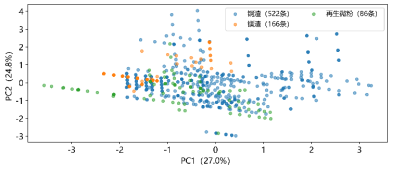
CO2 uptake through the carbonation of industrial solid wastes represents an important technological pathway toward carbon neutrality, with performance jointly influenced by feedstock composition and process conditions. However, differences in data sources and feedstock characteristics complicate reliable prediction and limit model applicability across materials. This study integrated 818 CO2 uptake records covering steel slag, magnesium slag, and recycled fine powder to establish a random forest framework incorporating grouped cross-validation, nested feature selection, and cross-feedstock transfer comparisons. Steel-slag models trained on literature data, compiled experimental data, and their combination were compared using common input features and consistent test groups. Connected groups based on feedstock composition and known literature sources were used to reduce information leakage between training and test sets. Joint training using steel-slag literature and experimental data achieved a mean absolute error (MAE) of 6.198 and a root mean squared error (RMSE) of 8.515. Permutation importance analysis and nested feature selection identified particle size, carbonation time, and reaction temperature as consistently retained predictors, although the optimal feature combination varied across validation folds. Feature-space comparisons revealed differences in feedstock composition and process conditions, motivating the evaluation of multiple transfer strategies using eight common features. With literature-derived steel-slag data as the source domain, joint training for magnesium slag and direct transfer for recycled fine powder reduced group-weighted MAE, with equal weight assigned to each group, by 26.7% and 32.3%, respectively, relative to random forest models trained solely on target-domain data. These findings demonstrate that steel-slag data can support CO2 uptake prediction for other solid wastes, while transfer benefits depend on the target feedstock and training strategy. The proposed framework provides a methodological basis for evaluating multisource data integration, identifying predictive features, and assessing model transferability across solid-waste feedstocks.
| Published in | Science Research (Volume 14, Issue 6) |
| DOI | 10.11648/j.sr.20261406.20 |
| Page(s) | 457-463 |
| Creative Commons |
This is an Open Access article, distributed under the terms of the Creative Commons Attribution 4.0 International License (http://creativecommons.org/licenses/by/4.0/), which permits unrestricted use, distribution and reproduction in any medium or format, provided the original work is properly cited. |
| Copyright |
Copyright © The Author(s), 2026. Published by Science Publishing Group |
Steel Slag, CO2 Uptake, Interpretable Machine Learning, Transfer Learning Across Feedstocks
特征组合 | MAE | RMSE | 组等权MAE |
|---|---|---|---|
12个特征 | 8.483 | 11.243 | 9.290 |
8个共同特征 | 9.196 | 11.958 | 10.413 |
共同特征内嵌套筛选模型 | 8.833 | 11.567 | 10.106 |
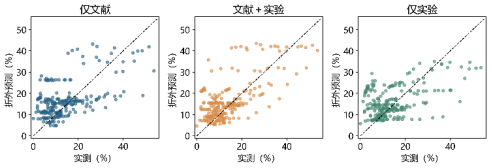
训练集 | MAE | RMSE | 组等权MAE |
|---|---|---|---|
文献数据 | 7.079 | 9.327 | 6.822 |
文献与实验数据 | 6.198 | 8.515 | 6.752 |
实验数据 | 6.890 | 9.361 | 8.495 |
数据来源与策略 | 镁渣 | 再生微粉 | ||||
|---|---|---|---|---|---|---|
MAE | RMSE | 组等权MAE | MAE | RMSE | 组等权MAE | |
仅目标域随机森林 | 10.415 | 11.990 | 9.153 | 17.274 | 18.925 | 16.437 |
文献数据:直接迁移 | 7.016 | 9.193 | 8.908 | 12.138 | 13.446 | 11.129 |
文献数据:预测加权适配 | 9.114 | 10.849 | 8.756 | 13.622 | 15.799 | 13.084 |
文献数据:联合训练 | 6.860 | 8.376 | 6.706 | 12.786 | 15.174 | 14.101 |
文献数据:相似度加权 | 6.266 | 8.077 | 8.024 | 12.504 | 13.765 | 11.484 |
合并数据:直接迁移 | 6.277 | 8.229 | 8.575 | 12.519 | 13.895 | 11.401 |
合并数据:预测加权适配 | 6.878 | 8.564 | 8.752 | 13.890 | 16.004 | 13.237 |
合并数据:联合训练 | 6.539 | 7.734 | 7.213 | 14.280 | 16.269 | 13.845 |
合并数据:相似度加权 | 6.395 | 8.316 | 9.091 | 11.834 | 14.085 | 11.413 |
| [1] | MA Y, LUO Y, MA H, et al. Upcycling steel slag in producing eco-efficient iron-calcium phosphate cement [J]. Journal of Cleaner Production, 2022, 371: 133688. |
| [2] | SONG Q, GUO M Z, WANG L, et al. Use of steel slag as sustainable construction materials: A review of accelerated carbonation treatment [J]. Resources, Conservation and Recycling, 2021, 173: 105740. |
| [3] | YANG Y, XU W, WANG Y, et al. Progress of CCUS technology in the iron and steel industry and the suggestion of the integrated application schemes for China [J]. Chemical Engineering Journal, 2022, 450: 138438. |
| [4] | JIANG Y, LING T C. Production of artificial aggregates from steel-making slag: Influences of accelerated carbonation during granulation and/or post-curing [J]. Journal of CO2 Utilization, 2020, 36: 135-144. |
| [5] | HUIJGEN W J J, WITKAMP G J, COMANS R N J. Mineral CO2 sequestration by steel slag carbonation [J]. Environmental Science & Technology, 2005, 39(24): 9676-9682. |
| [6] | 刘松辉, 张程, 管学茂. CO2协同镁渣基固废制备纤维板及其性能与微结构 [J]. 硅酸盐学报, 2023, 51(9): 2166-2178. |
| [7] | 吴扬, 周鹏程, 仇建国, 等. 基于加速固碳活化的再生微粉水泥稳定淤泥性能研究 [J]. 土木工程与绿色建筑, 2025, 1(2): 96-99. |
| [8] | HE B, ZHU X, CANG Z, et al. Interpretation and prediction of the CO2 sequestration of steel slag by machine learning [J]. Environmental Science & Technology, 2023, 57(46): 17940-17949. |
| [9] | GUO H, JIAO W, ZHANG M, et al. Prediction of CO2 sequestration rate of steel slag and economic feasibility analysis [J/OL]. Journal of Environmental Sciences, 2026: 105712. |
| [10] | DEVI R, BUTLER K T, SAI GAUTAM G. Leveraging transfer learning for accurate estimation of ionic migration barriers in solids [J]. npj Computational Materials, 2026, 12: 88. |
| [11] | PAN S J, YANG Q. A survey on transfer learning [J]. IEEE Transactions on Knowledge and Data Engineering, 2010, 22(10): 1345-1359. |
| [12] | WANG Z, DAI Z, PÓCZOS B, et al. Characterizing and avoiding negative transfer [C]//Proceedings of the IEEE/CVF Conference on Computer Vision and Pattern Recognition. 2019: 11293-11302. |
| [13] | BREIMAN L. Random forests [J]. Machine Learning, 2001, 45(1): 5-32. |
| [14] | AGUIAR L G, KASEMODEL M C. Application of random forest regression in modeling the adsorption of methylene blue onto clays [J]. Neural Computing and Applications, 2026, 38: 496. |
| [15] | FISHER A, RUDIN C, DOMINICI F. All models are wrong, but many are useful: Learning a variable’s importance by studying an entire class of prediction models simultaneously [J]. Journal of Machine Learning Research, 2019, 20(177): 1-81. |
| [16] | JOLLIFFE I T, CADIMA J. Principal component analysis: A review and recent developments [J]. Philosophical Transactions of the Royal Society A: Mathematical, Physical and Engineering Sciences, 2016, 374(2065): 20150202. |
APA Style
Wei, X., Zhang, Y., Xia, L., He, M., Meng, J. (2026). Interpretable Prediction of CO2 Uptake Using Multi-Source Steel Slag Data and Transfer Learning Across Feedstocks. Science Research, 14(6), 457-463. https://doi.org/10.11648/j.sr.20261406.20
ACS Style
Wei, X.; Zhang, Y.; Xia, L.; He, M.; Meng, J. Interpretable Prediction of CO2 Uptake Using Multi-Source Steel Slag Data and Transfer Learning Across Feedstocks. Sci. Res. 2026, 14(6), 457-463. doi: 10.11648/j.sr.20261406.20
AMA Style
Wei X, Zhang Y, Xia L, He M, Meng J. Interpretable Prediction of CO2 Uptake Using Multi-Source Steel Slag Data and Transfer Learning Across Feedstocks. Sci Res. 2026;14(6):457-463. doi: 10.11648/j.sr.20261406.20
@article{10.11648/j.sr.20261406.20,
  author = {Xin Wei and Yi Zhang and Lingfeng Xia and Mengjiao He and Jingyi Meng},
  title = {Interpretable Prediction of CO2 Uptake Using Multi-Source Steel Slag Data and Transfer Learning Across Feedstocks},
  journal = {Science Research},
  volume = {14},
  number = {6},
  pages = {457-463},
  doi = {10.11648/j.sr.20261406.20},
  url = {https://doi.org/10.11648/j.sr.20261406.20},
  eprint = {https://article.sciencepublishinggroup.com/pdf/10.11648.j.sr.20261406.20},
  abstract = {CO2 uptake through the carbonation of industrial solid wastes represents an important technological pathway toward carbon neutrality, with performance jointly influenced by feedstock composition and process conditions. However, differences in data sources and feedstock characteristics complicate reliable prediction and limit model applicability across materials. This study integrated 818 CO2 uptake records covering steel slag, magnesium slag, and recycled fine powder to establish a random forest framework incorporating grouped cross-validation, nested feature selection, and cross-feedstock transfer comparisons. Steel-slag models trained on literature data, compiled experimental data, and their combination were compared using common input features and consistent test groups. Connected groups based on feedstock composition and known literature sources were used to reduce information leakage between training and test sets. Joint training using steel-slag literature and experimental data achieved a mean absolute error (MAE) of 6.198 and a root mean squared error (RMSE) of 8.515. Permutation importance analysis and nested feature selection identified particle size, carbonation time, and reaction temperature as consistently retained predictors, although the optimal feature combination varied across validation folds. Feature-space comparisons revealed differences in feedstock composition and process conditions, motivating the evaluation of multiple transfer strategies using eight common features. With literature-derived steel-slag data as the source domain, joint training for magnesium slag and direct transfer for recycled fine powder reduced group-weighted MAE, with equal weight assigned to each group, by 26.7% and 32.3%, respectively, relative to random forest models trained solely on target-domain data. These findings demonstrate that steel-slag data can support CO2 uptake prediction for other solid wastes, while transfer benefits depend on the target feedstock and training strategy. The proposed framework provides a methodological basis for evaluating multisource data integration, identifying predictive features, and assessing model transferability across solid-waste feedstocks.},
 year = {2026}
}
TY  - JOUR
T1  - Interpretable Prediction of CO2 Uptake Using Multi-Source Steel Slag Data and Transfer Learning Across Feedstocks
AU  - Xin Wei
AU  - Yi Zhang
AU  - Lingfeng Xia
AU  - Mengjiao He
AU  - Jingyi Meng
Y1  - 2026/11/10
PY  - 2026
N1  - https://doi.org/10.11648/j.sr.20261406.20
DO  - 10.11648/j.sr.20261406.20
T2  - Science Research
JF  - Science Research
JO  - Science Research
SP  - 457
EP  - 463
PB  - Science Publishing Group
SN  - 2329-0927
UR  - https://doi.org/10.11648/j.sr.20261406.20
AB  - CO2 uptake through the carbonation of industrial solid wastes represents an important technological pathway toward carbon neutrality, with performance jointly influenced by feedstock composition and process conditions. However, differences in data sources and feedstock characteristics complicate reliable prediction and limit model applicability across materials. This study integrated 818 CO2 uptake records covering steel slag, magnesium slag, and recycled fine powder to establish a random forest framework incorporating grouped cross-validation, nested feature selection, and cross-feedstock transfer comparisons. Steel-slag models trained on literature data, compiled experimental data, and their combination were compared using common input features and consistent test groups. Connected groups based on feedstock composition and known literature sources were used to reduce information leakage between training and test sets. Joint training using steel-slag literature and experimental data achieved a mean absolute error (MAE) of 6.198 and a root mean squared error (RMSE) of 8.515. Permutation importance analysis and nested feature selection identified particle size, carbonation time, and reaction temperature as consistently retained predictors, although the optimal feature combination varied across validation folds. Feature-space comparisons revealed differences in feedstock composition and process conditions, motivating the evaluation of multiple transfer strategies using eight common features. With literature-derived steel-slag data as the source domain, joint training for magnesium slag and direct transfer for recycled fine powder reduced group-weighted MAE, with equal weight assigned to each group, by 26.7% and 32.3%, respectively, relative to random forest models trained solely on target-domain data. These findings demonstrate that steel-slag data can support CO2 uptake prediction for other solid wastes, while transfer benefits depend on the target feedstock and training strategy. The proposed framework provides a methodological basis for evaluating multisource data integration, identifying predictive features, and assessing model transferability across solid-waste feedstocks.
VL  - 14
IS  - 6
ER  -
Zhong Cun·Big·Data Technology Company Limited,·Beijing, China
Zhong Cun·Big·Data Technology Company Limited,·Beijing, China
Zhong Cun·Big·Data Technology Company Limited,·Beijing, China
Zhong Cun·Big·Data Technology Company Limited,·Beijing, China
Zhong Cun·Big·Data Technology Company Limited,·Beijing, China

Information



 Share This Article
 Twitter
 Linked In
 Facebook

 Copy
 Download